

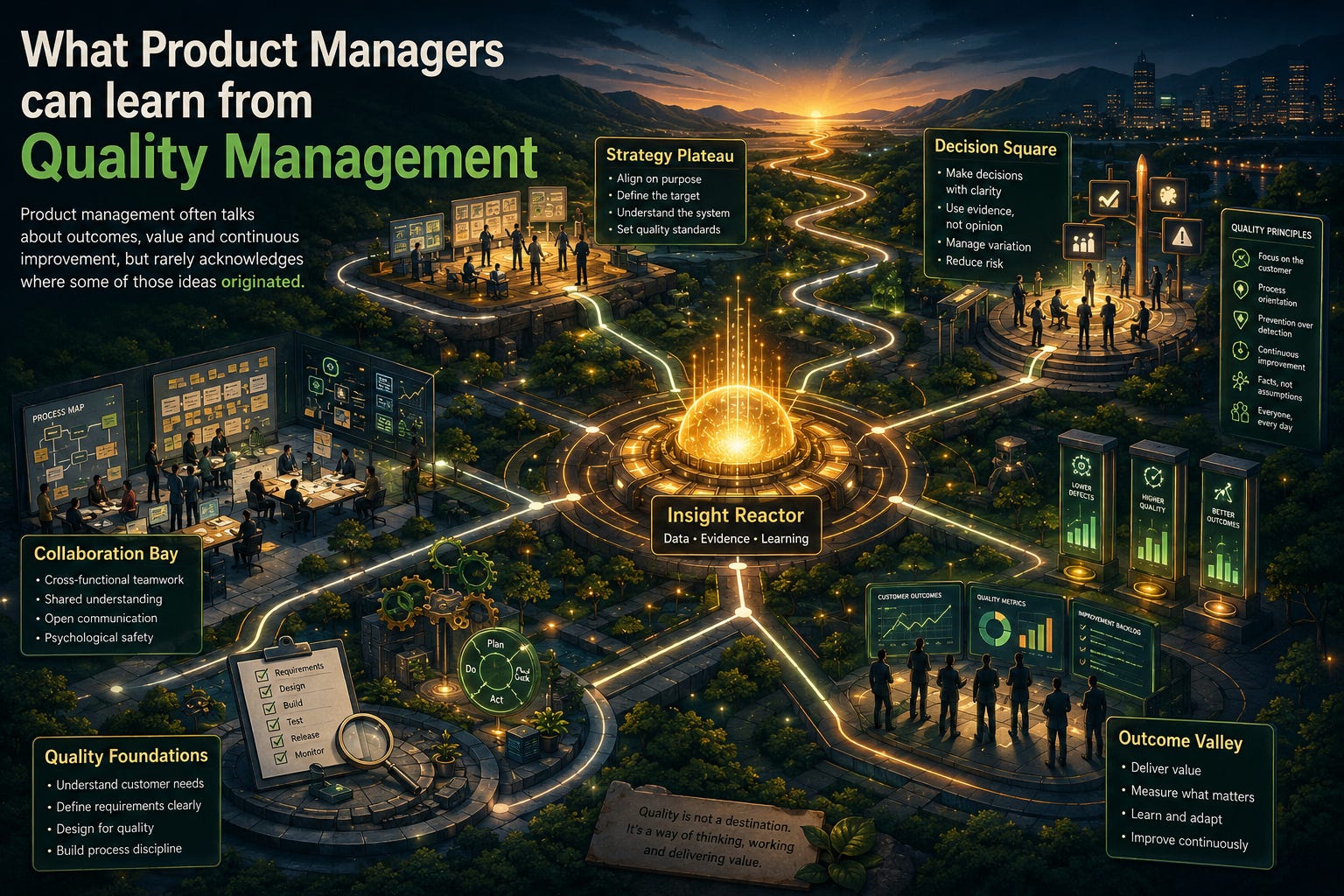
Quality management has been addressing similar challenges for decades. How to deliver consistently. How to reduce waste. How to manage risk. How to improve outcomes over time without exhausting teams or relying on heroic effort.
Despite its manufacturing roots, quality management has clear lessons for modern product teams, particularly those working in complex, regulated or high-stakes environments.
Quality is about reliability, not perfection
In product management, quality is often equated with polish or the absence of bugs. In quality management, it means something more practical: the ability to meet user needs reliably over time.
A high-quality product behaves predictably, fails safely and improves through evidence rather than opinion. It delivers value consistently rather than occasionally. For internal platforms and public-sector services, reliability and trust often matter more than novelty.
Kaizen fits product work naturally
Kaizen, or continuous improvement, aligns closely with how effective product teams operate.
Rather than relying on large redesigns or periodic roadmap resets, Kaizen encourages small changes, frequent learning and steady progress. In practice, this means using user insight and service data to make regular, low-risk improvements. Refining flows, simplifying journeys, reducing operational friction and removing unnecessary process.
None of these changes are dramatic in isolation, but together they compound.
Process matters as much as features
Quality management places as much emphasis on how work happens as on what is delivered. This is a useful for product teams that focus heavily on roadmaps while ignoring flow, bottlenecks and decision-making friction.
For product managers, this means improving prioritisation, reducing hand-offs, strengthening cross-functional collaboration and spotting waste such as excessive meetings, rework or unclear ownership. Better processes improve both delivery speed and decision quality.
Measure what helps you learn
Quality management is data-driven without being metric-obsessed. Measures exist to understand whether the system is working, not to perform for dashboards.
For product teams, this means asking whether users are succeeding, where work stalls, which issues repeat and how demand changes over time. Metrics should support learning and decision-making, not create noise.
Quality is ultimately a leadership choice
Quality does not emerge from tools or frameworks alone. It is a leadership stance.
Product leaders who take quality seriously prioritise long-term outcomes, treat risk as something to manage rather than ignore, invest in team capability and create space for continuous improvement. This does not slow teams down, it helps them move with confidence and sustainability.
Final thought
You do not need formal quality certifications to benefit from quality management thinking. The value lies in the mindset of continuous improvement. Evidence over opinion and systems over silos.
In a product world focused on speed, quality management offers something more valuable, momentum without chaos.