

The problem we think we have
The public sector doesn’t have a talent problem, it has an incentive problem.
That’s not a criticism of the people working in it. If anything, it’s the opposite. Across government and public services, I’ve consistently seen capable product managers, thoughtful engineers and committed delivery teams — people who understand what good looks like.
And yet delivery still feels slow, decisions still take too long and teams still struggle to make meaningful progress.
So the question isn’t why people aren’t good enough. It’s why capable people consistently produce constrained outcomes.
The problem we actually have
When delivery struggles, the explanations are familiar. We talk about capability, leadership and the need to adopt better practice. These are comforting answers because they suggest the problem can be solved by improving people.
But they miss something more fundamental: the environment those people are operating in.
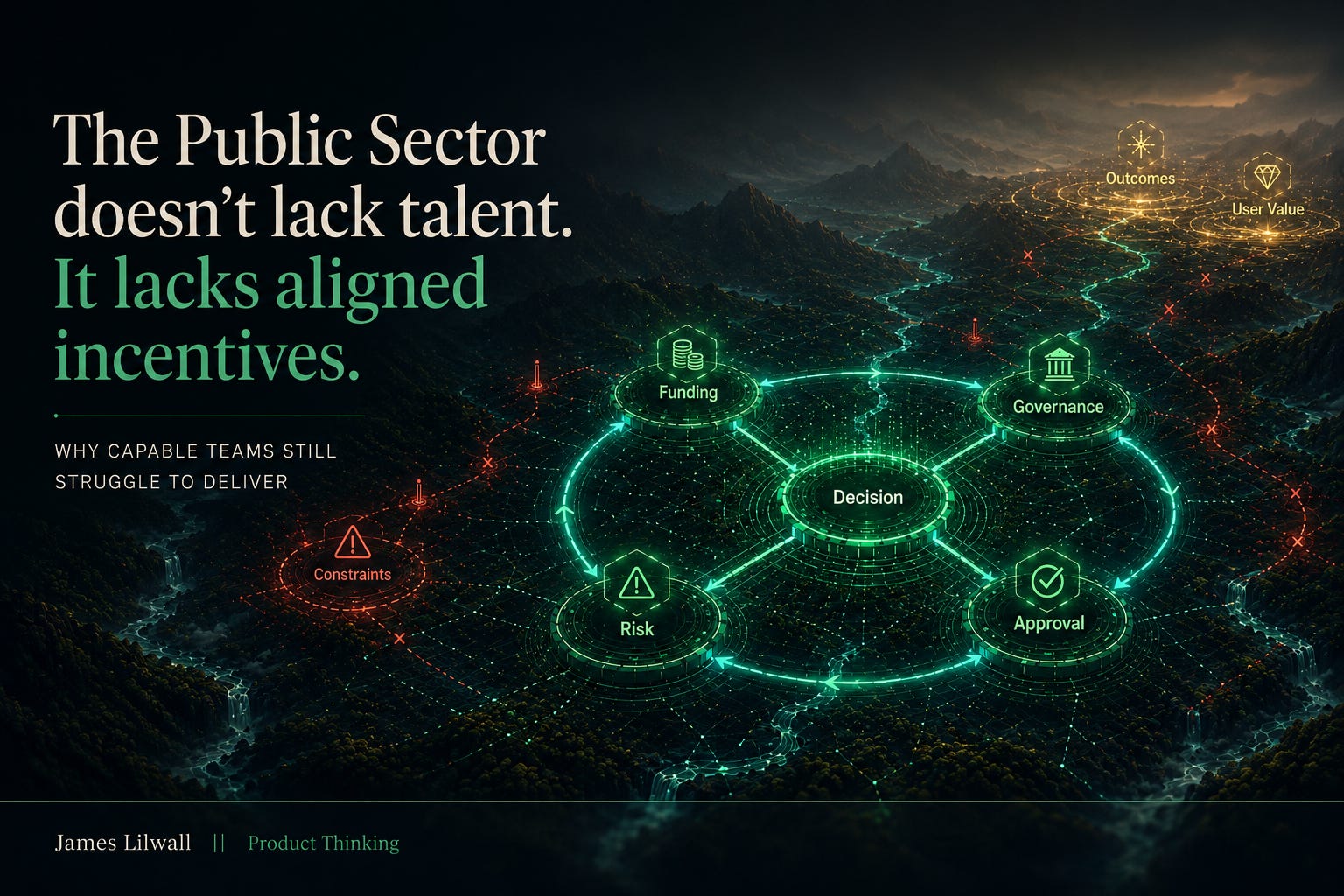
In complex organisations, behaviour is shaped less by intent and more by incentives. Not just financial incentives, but the broader system of funding cycles, governance structures, accountability models and risk exposure. These define what is safe to do, what is rewarded, and what is quietly avoided.
Over time they shape how teams behave.
This is a systems problem. Outcomes are not just shaped by individual decisions, but by the structure those decisions sit within.
Why risk aversion is rational
“Risk aversion” is often framed as a cultural issue in the public sector. In practice, it is usually a rational response to the system.
If decisions are highly scrutinised, failure is visible and success is rarely attributed, then the safest path is not to make bold product decisions. It is to avoid decisions that could go wrong.
That doesn’t mean people don’t want to do better work, it means the system doesn’t consistently support it.
How the system shapes delivery
Once you start looking through this lens, familiar patterns become easier to explain. Roadmaps are driven by funding cycles rather than user need. Delivery is shaped by governance gates rather than learning loops. Teams optimise for approval rather than outcomes.
None of this requires bad intent, it is what happens when the system rewards compliance more than effectiveness.
Why best practice struggles to land
This is also why so many well intentioned improvements struggle to take hold.
Product practices such as outcome-based thinking, product operating models and continuous discovery are designed to improve how teams work. But when success is still measured through milestones, reporting and approvals, those practices tend to become overlays rather than drivers of behaviour.
Similarly, approaches that rely on learning and iteration assume space to adapt. Where scope is fixed upfront and funding is tied to delivery commitments, that space becomes limited.
Concepts like incremental delivery are intended to reduce risk. In high-scrutiny environments, even small changes can feel disproportionately risky. The result is often a preference for larger, more certain deliveries, even when they carry greater long-term risk.
These ideas are not new. What is less understood is how difficult they are to apply in constrained environments.
What can actually be done
Understanding the system doesn’t automatically give you the ability to change it and most product managers don’t have the authority to redesign the incentives they’re operating within.
But that doesn’t mean you’re powerless. The most useful shift I’ve seen is simply making the incentives visible. Teams often feel the constraints they are under, but rarely articulate them. In practice, this means being explicit about what is actually driving decisions, i.e. what is being rewarded, what is being avoided and where the real risk sits.
When those dynamics are surfaced, conversations change. The focus moves away from whether the team is “doing the right thing” and towards what the system is encouraging them to do.
The second shift is learning to work with constraints rather than around them. In most public sector environments, governance, funding and approval processes are not going away. Trying to bypass them usually creates more friction, not less.
What tends to work better is shaping work to fit within those constraints while still moving things forward. That might mean breaking work into smaller, lower-risk increments that can pass through existing approval structures, or reframing decisions in terms that align with how the organisation already measures success.
This is less about applying best practice perfectly and more about adapting it so it can survive in the system it sits within.
And perhaps most importantly, it requires recognising the limits of your influence. You can improve how your team works. You can create space for better decisions. You can shift how conversations happen.
But you are unlikely to change funding cycles or governance models on your own.
The goal is not to fix the system in one move. It is to create small shifts in how it behaves, which over time can lead to more meaningful change.
The constraint we need to engage with
Public sector delivery does not struggle because people lack capability. It struggles because the system they are operating in does not consistently support good outcomes.
Until incentives change, behaviour will not change.
And that leaves product managers with a different challenge than the one they are often given.
Not just to deliver better outcomes but to understand the system they are operating in and find ways to make it work differently.