

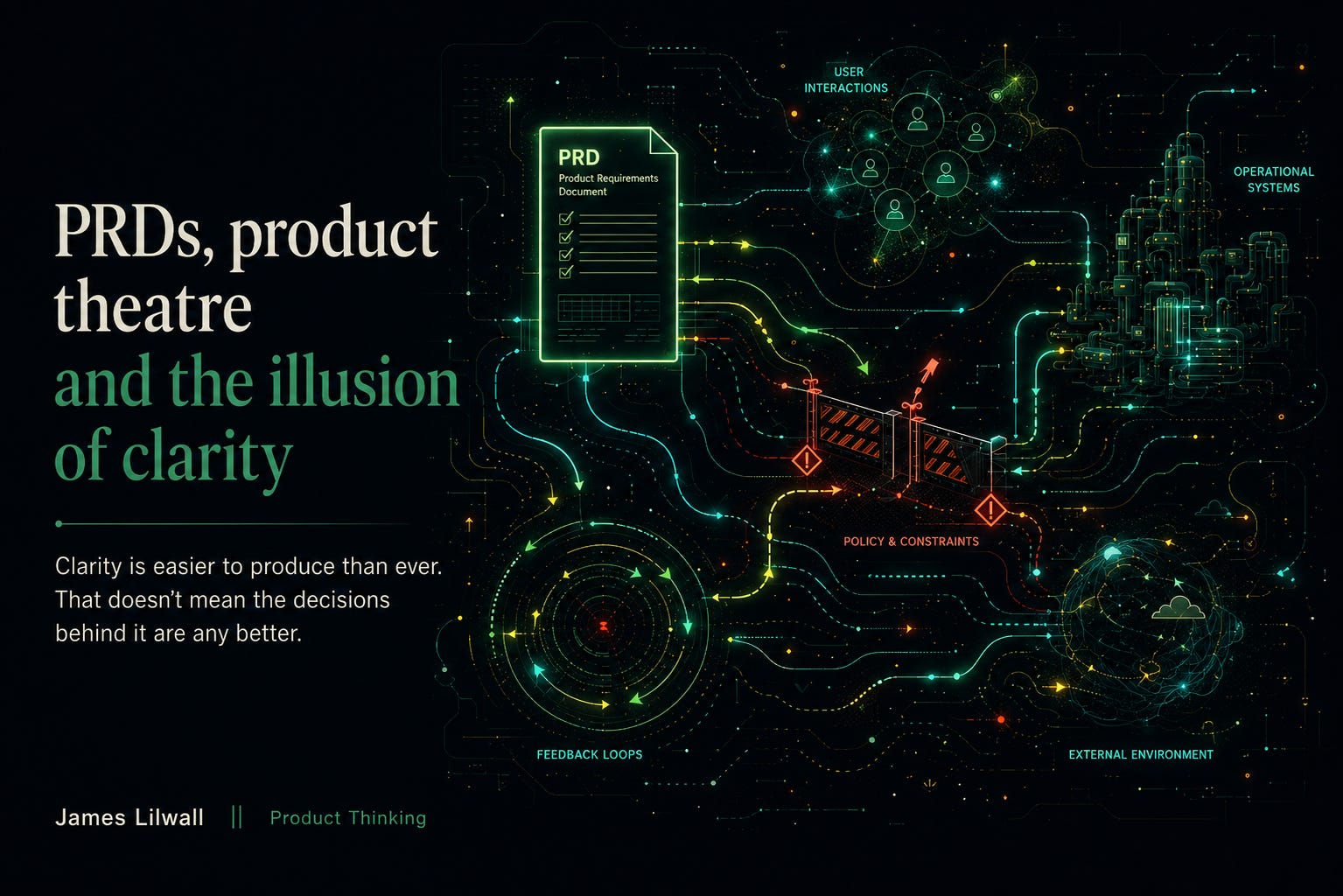
A well-written PRD can be completely wrong and still move a team forward. It can define a clear problem, a plausible user, coherent success metrics and a structured solution. It can pass review, align stakeholders and create momentum. And yet, it can still fail to improve anything that matters.
This is not because the document is poorly written, it is because it is convincing enough.
The clarity it presents can justify action even when the underlying understanding is incomplete, that is where the risk sits.
The PRD was never the decision
At their best, PRDs were not intended to be deliverables. They were thinking tools, ways of forcing articulation of the problem, the value and the trade-offs involved. The document itself mattered far less than the decisions required to produce it.
A more accurate framing is that a PRD should clarify or record decisions, not replace the discovery and judgement needed to make them.
A good PRD reflects decisions that have already been made, often through challenge, disagreement and iteration, rather than acting as a substitute for that process. The issue is not the existence of the document, but the role it begins to play.
In some organisations, the PRD becomes the centre of gravity, with conversations orbiting the document rather than the problem it is meant to represent. Clarity becomes something that is presented, rather than something that has been earned through understanding.
When clarity becomes theatre
A structured PRD creates a powerful sense of confidence. It suggests that the problem is understood, that the solution is appropriate, that the risks are known and that the path forward is coherent. The structure itself implies rigour, which makes the document persuasive.
However, none of these things are guaranteed. A document can be internally consistent and still be fundamentally wrong. It can describe the wrong problem with precision, define success using metrics that do not matter, or outline a solution that ignores the system it sits within. Because it is well written, it often becomes harder to challenge rather than easier.
This is where clarity becomes theatre. Not because anyone is intentionally misleading, but because the document performs the role of understanding. It creates a shared sense that the work has been thought through, even when important uncertainties remain unresolved. Karl Weick’s work helps explain why this is so effective: organisations rely on coherent narratives to coordinate action, even when those narratives are incomplete.
In complex delivery environments, this pattern becomes visible. I have seen this in public sector work, where a problem is documented cleanly with agreed success metrics and a clear solution path, while the real drivers sit outside the document in policy constraints, operational pressures and organisational risk tolerance. The PRD is coherent, but the system it describes is not. The result is predictable: the solution addresses what is written down, rather than what is actually happening.
This is what product theatre can look like. The artefact appears complete, the logic is sound and the presentation is convincing, but the underlying understanding remains partial and fragile.
Static documents in dynamic systems
PRDs capture a moment in time. They represent a snapshot of what is believed to be true about a problem, a solution and a path forward. At the point of writing, that snapshot can feel accurate and aligned.
However, product environments are not static. Assumptions change, constraints shift and new information emerges as teams learn more about users, systems and outcomes. In many teams, the PRD does not evolve at the same pace as the team’s understanding. Sometimes it becomes a historical artefact that is still referenced despite no longer reflecting reality. More often, it is updated just enough to remain credible, without reopening the decisions it was built on.
This creates divergence. The document reflects past thinking, while the team operates on current understanding. The gap between the two is rarely explicit, but it is where misalignment begins. This is not simply a process issue; it reflects a deeper mismatch between static artefacts and dynamic environments. Henry Mintzberg argued that strategy often emerges through action rather than being fully defined upfront, and product work behaves in much the same way. A document that assumes completeness at the start will always struggle to accommodate learning as it unfolds.
What AI risks doing
AI does not just make PRDs easier to write, it changes what they signal. For a long time, a clear and well-structured PRD implied that decisions had been made through analysis, discussion and trade-offs. That implication is now weaker.
AI tools are highly effective at producing structured, coherent documents. They can generate plausible problem statements, user needs that appear credible and well-formed success metrics. What they cannot do is determine whether any of these are grounded in reality. The risk is not poor quality, but unearned credibility.
This matters because it changes how PRDs are interpreted. A polished document used to suggest that someone had done the work required to reach that level of clarity. Now, that same level of clarity can be produced with far less underlying effort. This does not make the document wrong, but it does make it harder to read.
Herbert Simon’s idea of bounded rationality is useful here. People already make decisions with simplified models of reality due to limited information and cognitive constraints. AI does not remove this limitation, it can reinforce it by making those simplified models appear more complete than they actually are.
The implication is practical, PRDs can no longer be read as reliable signals of rigour. They need to be treated as hypotheses about reality, rather than representations of it. This shifts how they should be challenged. Instead of asking whether the document is clear, teams need to ask what evidence supports the problem, what assumptions are being made, what constraints are being excluded and what would change their mind. The document itself cannot answer these questions, but it can obscure the need to ask them.
A well-written PRD is now a much weaker signal than it once was. It tells us less than it used to about whether sound decisions have been made.
What this means
The PRD is not the decision. A clear document is not evidence of a good decision, it is evidence that something has been articulated well. This distinction matters more as the cost of producing clarity continues to fall.
The implication is not that PRDs are useless, but that their role is often misunderstood. The value of product management lies less in producing structured artefacts and more in making decisions under uncertainty, understanding systems rather than isolated features, navigating competing incentives and defining value rather than simply describing it. These activities are harder to document and far harder to replicate or generate convincingly.
Take home
PRDs persist because they are organisationally useful. They create a sense of control, provide something tangible to review, and support governance. But that usefulness comes with risk. When the document becomes the signal, it becomes easier to believe that clarity exists when it does not. And now that clarity can be generated quickly and convincingly, that illusion is stronger than ever.
A well-written PRD is now a much weaker signal than it once was.
The question is no longer whether it is clear.
It is whether it is true.