

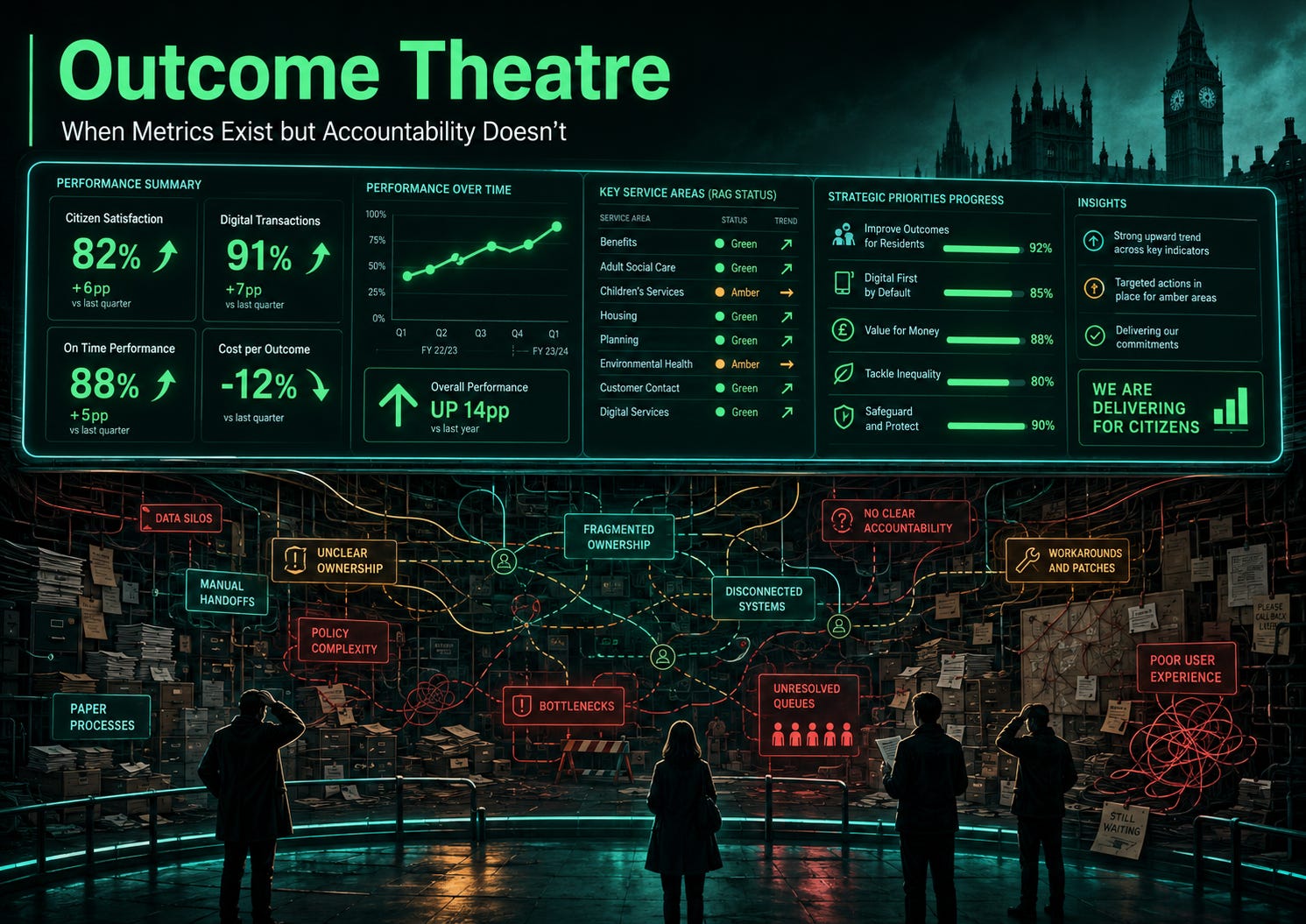
The problem with modern organisations is not a lack of metrics, it is that they use metrics as a substitute for accountability.
Dashboards proliferate and quarterly reviews get slicker. OKRs are cascaded and service standards are published. Transformation programmes come with benefits maps, KPI packs and performance frameworks, and everyone can point to a number.
And yet, when outcomes worsen, trust falls, users struggle, staff work around broken processes, or costs migrate somewhere less visible, it is often unclear who is meant to notice, who has the authority to act and which evidence actually counts.
That is what I mean by outcome theatre. It is what happens when an organisation can prove it is measuring performance, but cannot prove it is governing performance.
This isn’t an argument against metrics, these matter. Without them, product teams drift into opinion, anecdote and stakeholder preference. Measurement gives us a way to see patterns, challenge assumptions and understand whether change is making a difference.
But metrics only become useful when they are connected to judgement, ownership and consequence.
Consider that:
A dashboard without decision rights is theatre.
A target without context is theatre.
A service metric without a service owner is theatre.
A transformation benefit without a baseline is theatre.
An outcome that nobody is accountable for changing is not really an outcome, it is just a line in a slide deck.
The dashboard is not the service
The UK public sector offers a useful version of the problem because the formal accountability machinery is arguably strong.
Ministers are accountable to Parliament, accounting officers are accountable for value for money. Departments publish annual reports and major programmes are scrutinised. Performance frameworks exist, audit bodies report and committees challenge.
And still, operational accountability often breaks down much earlier.
The Public Accounts Committee has pointed to a lack of single service owners, weak end-to-end cost visibility, and insufficient service-level performance information across government. In 2023, only 10 of government’s Top 75 services were assessed as “great”, while 45 required significant improvement.
The larger point is not the score itself, it is what sat beneath it: weak end-to-end ownership, limited cost visibility and a lack of clear accountability for whole services.
That is the first uncomfortable truth. You can have metrics and still not have a governable service. Without an accountable owner for the whole journey, the dashboard becomes a collage of partial truths.
Digital teams report the front end, operations report throughput, finance reports cost, policy reports intent, suppliers report delivery, senior leaders report confidence and so on. But the user experiences the service as a single thing. The organisation experiences it as many things.
That is where the theatre begins. Each part of the system can look defensible from where it stands, while the overall service remains difficult, expensive, slow or unfair. Nobody is necessarily lying, as the problem is more subtle than that. The metrics are true within their own boundaries, but the boundaries are wrong.
HMRC and the problem with channel success
HMRC, the UK tax authority is one of the clearest recent examples.
On one reading, the story looks like digital progress. More people are using online tax accounts, apps and digital services. HMRC reported high satisfaction among users of its digital services. From a channel perspective, that sounds positive.
But from a service perspective, the picture is much less comfortable.
The National Audit Office reported that customers and agents spent the equivalent of 798 years waiting to speak to an HMRC adviser in 2022–23. In the first 11 months of 2023–24, HMRC answered just two-thirds of attempts to speak to an adviser, against a target of 85%. Those who got through waited nearly 23 minutes on average.
The NAO also found that HMRC’s digital services were better suited to straightforward issues, that 69% of people who used both phone and online channels had phoned because they could not resolve the issue online and that HMRC did not yet know enough about whether its digital services were actually meeting customers’ needs.
That is outcome theatre in miniature. The digital channel can improve while the service gets worse for people whose needs do not fit the digital path, i.e. a satisfaction score can look strong while unresolved demand builds elsewhere. A digital-first strategy can sound efficient while quietly increasing the burden on people with complex circumstances, low confidence, poor access or a need for human explanation.
The issue is not that digital is bad, they can be faster, cheaper and better. The issue is that channel metrics can conceal service failure when they are treated as the whole truth. A product manager should always be suspicious when a metric improves in one part of the system while complaints, repeat contact, manual workarounds or user confusion rise somewhere else.
That is usually not transformation, it is displacement.
Goodhart always turns up eventually
Goodhart’s law is commonly expressed as: when a measure becomes a target, it ceases to be a good measure. It remains one of the most important ideas in product governance, the moment a metric becomes tied to funding, status, reputation, bonus, promotion or political claim, people start optimising for the metric.
Sometimes that is useful as clear targets can focus attention. But the failure mode is obvious as people begin to improve the number without improving the reality beneath it. For example, a sprint velocity metric becomes pressure to ship more, not better. A retention metric becomes pressure to make cancellation harder, not the product more valuable and so on. In the end, the measure becomes the game.
Proxy error is the quiet failure
The most dangerous metrics are not always the obviously bad ones, instead they are the ones that are almost right. Completion rate is not useless, nor are others such as cost per transaction or revenue. But none of these are the outcome by themselves.
Completion rate does not tell you whether the user understood what they were doing, cost per transaction does not tell you whether cost has been pushed into another channel and revenue does not tell you whether value was created responsibly, sustainably or fairly.
This is proxy error: the organisation mistakes a signal for the thing itself and it happens because proxies are convenient. They are standardised and they are easy to collect. They fit in a dashboard and can be compared across teams. They are legible to senior stakeholders.
Real outcomes are messier and require interpretation. They cross organisational boundaries, show up in complaints, operational workarounds, staff judgement, user research, unequal impacts, demand patterns and long-term consequences. They rarely fit neatly into a single number.
The Department for Business and Trade’s own evaluation and performance analysis strategy makes this point clearly. It says that as digital teams move beyond replacing administrative tasks into delivering public services digitally, they need to understand social impact. Standard GDS indicators such as completion rate and cost per transaction are useful, but not sufficient.
That matters because it comes from inside the public-sector measurement system itself. The problem is not measurement, but is mistaking service indicators for the whole account of public value.
Weak organisations prefer proxy certainty to outcome ambiguity. They feels safer and look more professional and can create the appearance of control. But product work lives in the gap between what is easy to measure and what actually matters.
Metrics and power
Metrics are not neutral as they decide what gets seen, what gets ignored and who gets believed. A dashboard is a political object, even when it looks technical, it can reflect choices about what counts as success, whose experience is represented, which costs are visible and which trade-offs can remain hidden.
This matters because dashboards often move upwards more easily than context does.
Senior leaders see red, amber and green, boards see trend lines, programme teams see delivery confidence and so on. But the people closest to the work often see something else. They see the manual workaround, users who cannot complete the journey, cases reopened after being marked resolved.
And such, outcome theatre thrives when the official metric is allowed to overrule lived operational evidence. This is where psychological safety and product governance meet. If teams cannot challenge the metric, the metric becomes a form of control. It stops being a tool for learning and becomes a tool for compliance.
The question is not just “what are we measuring?” but also “who is allowed to say the measure is wrong?”
The AI amplification problem
AI will make this problem worse unless organisations are careful, because it makes measurement cheaper, faster and more abundant.
AI can generate summaries, classify feedback, produce sentiment analysis, create dashboards, detect trends, score interactions and automate reporting. Used well, that could help organisations see more. Used badly, it will help them produce more convincing theatre.
More metrics do not automatically create more accountability. In fact, the opposite can happen. The organisation can become flooded with things that resemble evidence but don’t carry real accountability. A product team can already drown in metrics and without care, AI makes it easier to drown elegantly.
The future problem may not be a lack of data, it may be too much weak evidence, produced too quickly, interpreted too confidently and connected too loosely to real decisions.
That is why the discipline around metrics needs to improve now; AI does not remove the need for ownership, baselines, challenge, context and consequence. It just makes them more important.
What product managers should do
Product managers cannot fix organisational accountability alone, but they can refuse to participate in outcome theatre. This starts with treating metrics as hypotheses, not facts.
A metric says: we believe this signal tells us something important about value, quality, risk or progress. That belief should be tested.
A product manager should ask:
What outcome is this metric meant to represent?
What behaviour will it create if people are rewarded for improving it?
How could this number improve while the real outcome gets worse?
Who is missing from the measurement?
What cost might be shifted elsewhere?
What would contradict the dashboard?
What decision will change if this metric moves?
Who has the authority to act?
The last two questions matter most, as if no decision changes, the metric is decorative and if nobody has authority to act, the metric is performative.
The counter-example matters
The strongest evidence against outcome theatre is not a better dashboard, it is better management. The National Audit Office described a DWP Scotland case where leaders shifted from holding people to account for individual task output towards supporting them to achieve outcomes for customers and making the workplace better.
Staff engagement increased by 5% in the second year of the new engagement approach and by a further 4% in the third. Over the same two-year period, customers not attending appointments decreased from 23.5% to 13.7%, failure to attend work search reviews decreased from 18.6% to 11.8%, and overall customer satisfaction increased by 8%.
This example matters because it stops this argument becoming anti-management or anti-measurement. The message is not “stop measuring people.”, but “measure in a way that makes better judgement harder to avoid.”
The shift is not just from one metric to another, it is from task control to outcome ownership. From compliance to engagement, from local output pressure to service improvement. That is the difference between measurement and accountability.
A better model: accountable evidence
The better approach is not fewer metrics, but better connected evidence.
Good product governance should have five things:
Ownership: Someone has to own the whole product or service, not just a channel, component or delivery plan.
A baseline: Teams need to know what they are comparing against. Better than what? Better for whom? Better over what period?
A balanced measure set: Every efficiency metric should be paired with quality, trust and equity measures. If speed improves but quality falls or digital take-up rises while vulnerable users lose access then that is not a clean success.
Shadow metrics: These are measures that help detect gaming and hidden harm but are not tied directly to reward. e.g. repeat contact, complaint, reopened cases, etc. These often tell you what the official dashboard cannot.
Consequence: There must be an agreed point at which the evidence triggers a decision.
Without consequence, measurement is observation, with it: measurement becomes governance.
The real test
Every organisation says it cares about outcomes, they use statements like: Outcome-led, evidence-based, user-centred. But the real test is not whether an organisation uses outcome language. The real test is what happens when the outcome evidence is inconvenient.
Does the roadmap change?
Does funding move?
Does the dashboard get corrected?
Does anyone with authority make a different decision?
If not, the organisation may have metrics, but it does not have accountability. This is the danger of outcome theatre. It lets organisations look mature while avoiding the harder work of ownership, judgement and consequence.
The point of metrics is not to make performance visible, but to make better decisions unavoidable.