

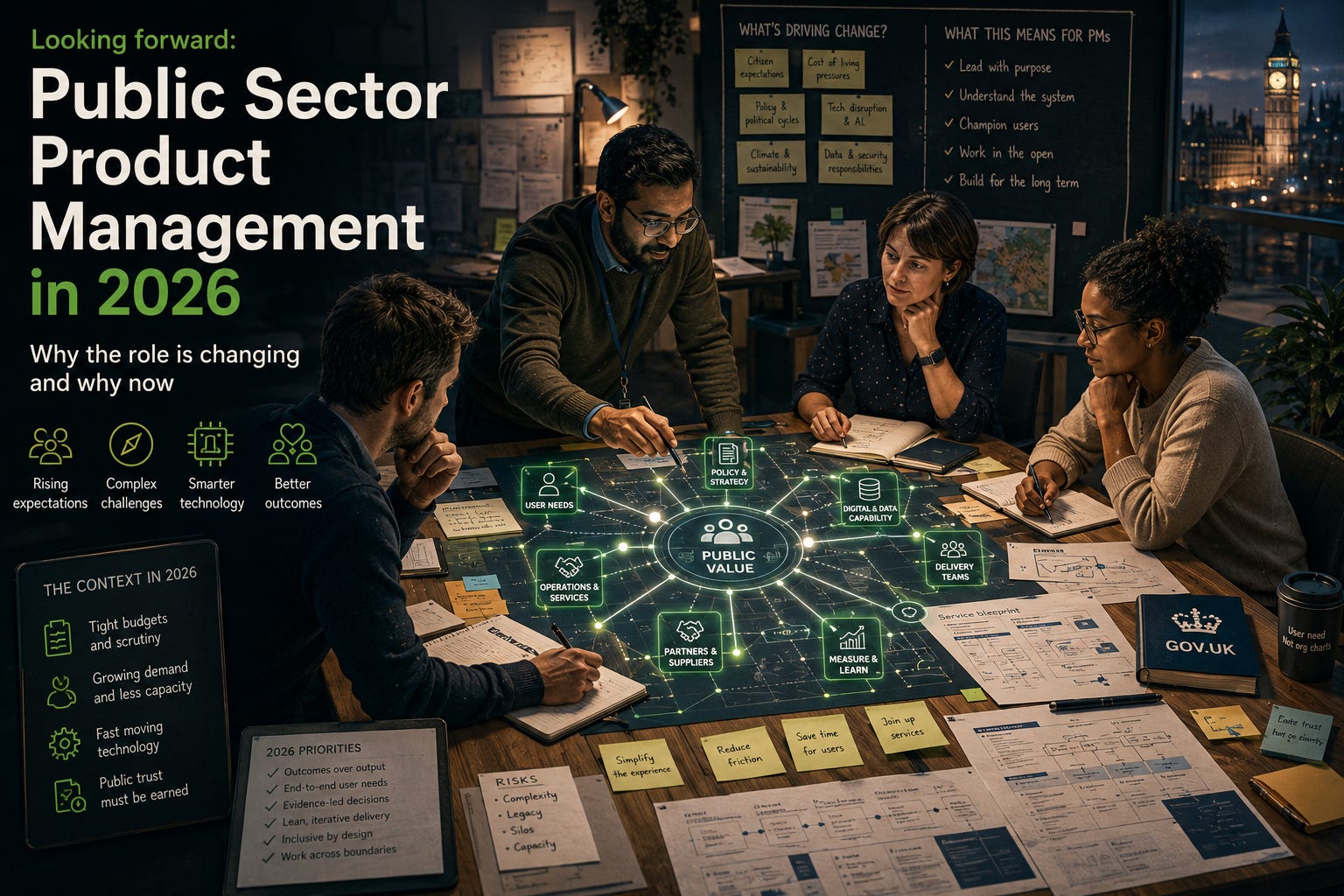
Public sector Product Management is not simply evolving by choice. The changes in 2026 are the result of accumulated pressure: financial constraint, operational risk, public scrutiny, technological acceleration and regulatory response. Due to demand, the role is shifting from digital delivery towards to strategic stewardship.
This article sets out what is changing in public-sector product management and why these changes are happening now.
From “digital transformation” to service stewardship: why the focus has shifted
Over the past decade, much of government’s digital effort was spent proving that digital delivery could work at all. By the mid-2020s that argument has largely been won and the challenge has moved on. Three forces explain this shift:
Legacy risk has become unavoidable
The National Audit Office (NAO) reporting over several years has shown that ageing systems are no longer just inefficient, but are operationally dangerous: vulnerable to cyber-attack, difficult to change and costly to run. Temporary fixes and front-end digitisation have deferred rather than removed these risks.Services need to operate continuously under pressure
Public services are facing higher demand, fewer staff and tighter budgets. That makes service reliability, integration and operability more important than launching new functionality.Central standards have matured
The Government Service Standard and Service Manual increasingly emphasise solving whole problems, measuring performance and operating services over time. This pushes accountability away from projects and towards long-lived services.
These factors explain why product management in 2026 is less about delivery phases and more about owning outcomes over time.
Why AI has moved from experimentation to governed use
The explosion of generative AI in 2023–24 created a wave of experimentation across the Public Sector. By 2026, that phase is necessarily ending. The reasons are structural:
Risk and scale
Early pilots demonstrated that AI can deliver value, but also that errors, bias or misuse can scale quickly in public services. This has triggered a shift from “try it and see” to formal governance.Regulatory and central guidance response
UK government guidance such as the Generative AI Framework and AI Playbook explicitly frames AI as a capability that must be deployed with controls, transparency and assurance. This reflects both legal risk and reputational risk.Operational reality
The most credible use cases are not headline-grabbing automation, but quieter augmentation of staff work: summarisation, drafting, triage and search. These require close integration into services, not isolated tools.
As a result, AI has become a wider ‘product concern’ in 2026 not due to fashion or trend, but because it is now too consequential to sit outside product accountability.
Why trust, security and privacy have become product outcomes
Security and privacy have always mattered in government, but they are now shaping product work more directly. This is happening because:
The attack opportunities have expanded
More digital services, more APIs and more data sharing mean more points of failure and legacy systems exacerbate this risk.Cyber incidents now have wider visible service impact
Disruptions are no longer abstract, they are mroe consequential and directly affect citizen access to services. That shifts responsibility upstream into product decision-making.Public expectations have changed
Citizens increasingly expect transparency about how their data is used, especially where AI is involved, trust can no longer be assumed.
Guidance such as Secure by Design reinforces this by placing lifecycle responsibility on delivery teams. In 2026, treating security as “technical debt” is no longer credible.
Why legacy modernisation is now unavoidable
Legacy modernisation has been discussed for years. What changed is the cost of not acting. By 2026:
The skills required to maintain older systems are scarcer
Integration costs rise with every new service dependency
Cyber vulnerabilities accumulate faster than they can be mitigated
Policy and service change cycles outpace system adaptability.
This explains why modernisation is no longer seen as a transformation programme, but as a continuous product strategy focused on risk reduction and sustainability. Therefore Product managers are becoming increasingly expected to articulate trade-offs, not just aspirations.
Why user-centred design is becoming more data-driven
User-centred design is not being replaced but it is being sharpened. The driver here is accountability. In an environment of constrained funding, teams must justify prioritisation decisions more clearly. Qualitative insight remains essential, but it is no longer sufficient on its own. Guidance now explicitly expects teams to:
Measure service performance
Understand demand and failure
Demonstrate improvement over time.
In 2026, evidence-led prioritisation is less about demonstrating maturity and more about justifying difficult decisions in constrained conditions.
Why procurement is shaping product work more directly
Procurement has always influenced delivery, but AI and platform dependency have increased the stakes. Cabinet Office guidance reflects concern about:
Hidden AI usage within supplier solutions
Ongoing vendor dependency
Accountability gaps when services fail.
This explains the move towards greater transparency, optional AI-specific procurement questions and outcome-based expectations. Product managers are brought into this because procurement decisions increasingly determine what is possible at a service level.
What this means overall: why product judgement matters more in 2026
The broader reason behind these changes is constraint. Public sector product management in 2026 is shaped by:
Financial pressure
Operational risk
Regulatory response
Technological acceleration
Public accountability.
As a result, Product Management will reward judgement more than process. The most effective product leaders will be those who can make trade-offs explicit, balance innovation with responsibility and sustain services that people rely on every day.