

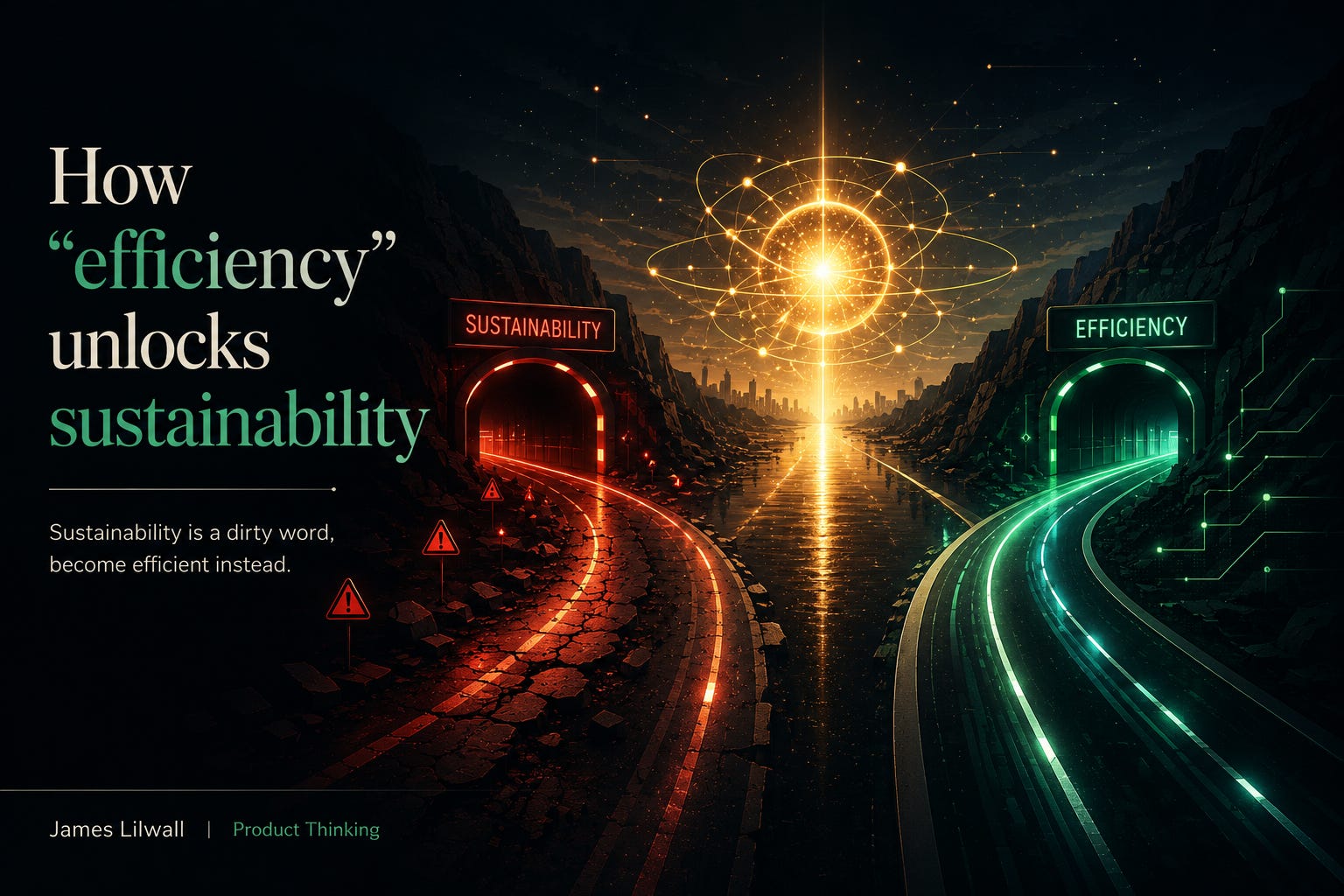
The framing problem we keep ignoring
Sustainability has a positioning problem, not a science problem, tooling or even a capability problem. A framing problem.
Say “sustainability” in most organisations and you trigger a predictable set of reactions: cost, compliance, trade-offs, slower delivery, “nice to have.” It gets mentally filed somewhere between the CSR report and next year’s strategy offsite.
Now replace the word.
Say “we need to become more efficient” and the reaction flips: cost reduction, performance improvement, competitive advantage, faster delivery, immediate action.
Same underlying behaviours, completely different response. That’s not semantics, its incentive alignment.
Sustainability doesn’t fail because it’s wrong. It fails because it’s mis-sold.
Most sustainability efforts are positioned as: do this because it’s good for the planet.
Which is true, but in most delivery environments, that’s not how decisions get made. Decisions are shaped by cost pressure, delivery timelines, risk and measurable outcomes. So sustainability gets treated as an additional constraint rather than a better way of operating.
Efficiency doesn’t have this problem. It’s already embedded in lean, Six Sigma, cost optimisation, performance engineering and product thinking. Nobody questions whether reducing waste is valuable, nobody challenges improving resource use.
Here’s the shift that matters:
Most sustainability practices are just efficiency practices viewed through a wider lens.
The examples are everywhere:
Reducing compute usage lowers cost and carbon.
Eliminating rework speeds delivery and reduces waste.
Extending device lifespan cuts spend and emissions.
Removing unnecessary features improves UX and reduces processing overhead.
This isn’t theoretical, for example:
Google reduced data centre energy consumption by focusing on efficiency, using AI to cut cooling energy by around 40%, with carbon reduction following as a consequence rather than the goal.
Cloud platforms like Amazon Web Services achieve lower emissions per workload not by leading with sustainability, but by maximising infrastructure utilisation and efficiency at scale.
You don’t need a new discipline, you need a different entry point.
The uncomfortable truth
Sustainability on its own often loses, efficiency almost always wins. Not because organisations don’t care, but because efficiency fits the system they operate in. Sustainability often doesn’t. So when you lead with sustainability, you create friction. When you lead with efficiency, you create momentum.
There’s a temptation to read this as reframing or manipulation, it isn’t. It’s recognising that organisations optimise for what they measure, language shapes what gets prioritised and incentives determine what actually happens.
If your goal is real-world impact, not just intent. Then you have to work with the system, not against it. That’s not greenwashing, that’s systems thinking.
What this means in practice
If you’re trying to embed sustainability into delivery, stop leading with it.
Reframe sustainability decisions as efficiency gains. Not “reduce environmental impact” but “reduce waste in the system.” The goal is the same, but the reception is different.
Quantify in business terms first. Cost per transaction, processing time, infrastructure usage, rework rates. Carbon becomes a secondary validation, not the primary pitch. Lead with the number that gets attention, then connect it to the broader outcome.
Design for less, not more. A lot of product work still operates on the assumption that more features equal more value, they often don’t. Less is frequently faster, cheaper, cleaner and better and this is where sustainability and product excellence align most naturally.
Challenge whether the work should exist at all. The most sustainable and most efficient outcome is often not doing the work. Unnecessary services, duplicated journeys, over-engineered solutions. This is where real impact sits and where most organisations struggle to go.
The shift
The goal isn’t to stop talking about sustainability, it’s to earn the right to talk about it by first delivering efficiency.
Once teams see the cost savings, the performance gains, the delivery improvements, then
sustainability stops being a constraint and becomes something credible, tangible and scalable. It earns a seat at the table rather than being invited to stand in the corridor.
One-line takeaway
If you want organisations to act sustainably, don’t ask them to be sustainable. Ask them to be efficient.
Final thought
Sustainability isn’t actually a dirty word, but in many organisations it behaves like one. Efficiency doesn’t. If both roads lead to the same destination, the only question worth asking is: which one actually gets travelled?