

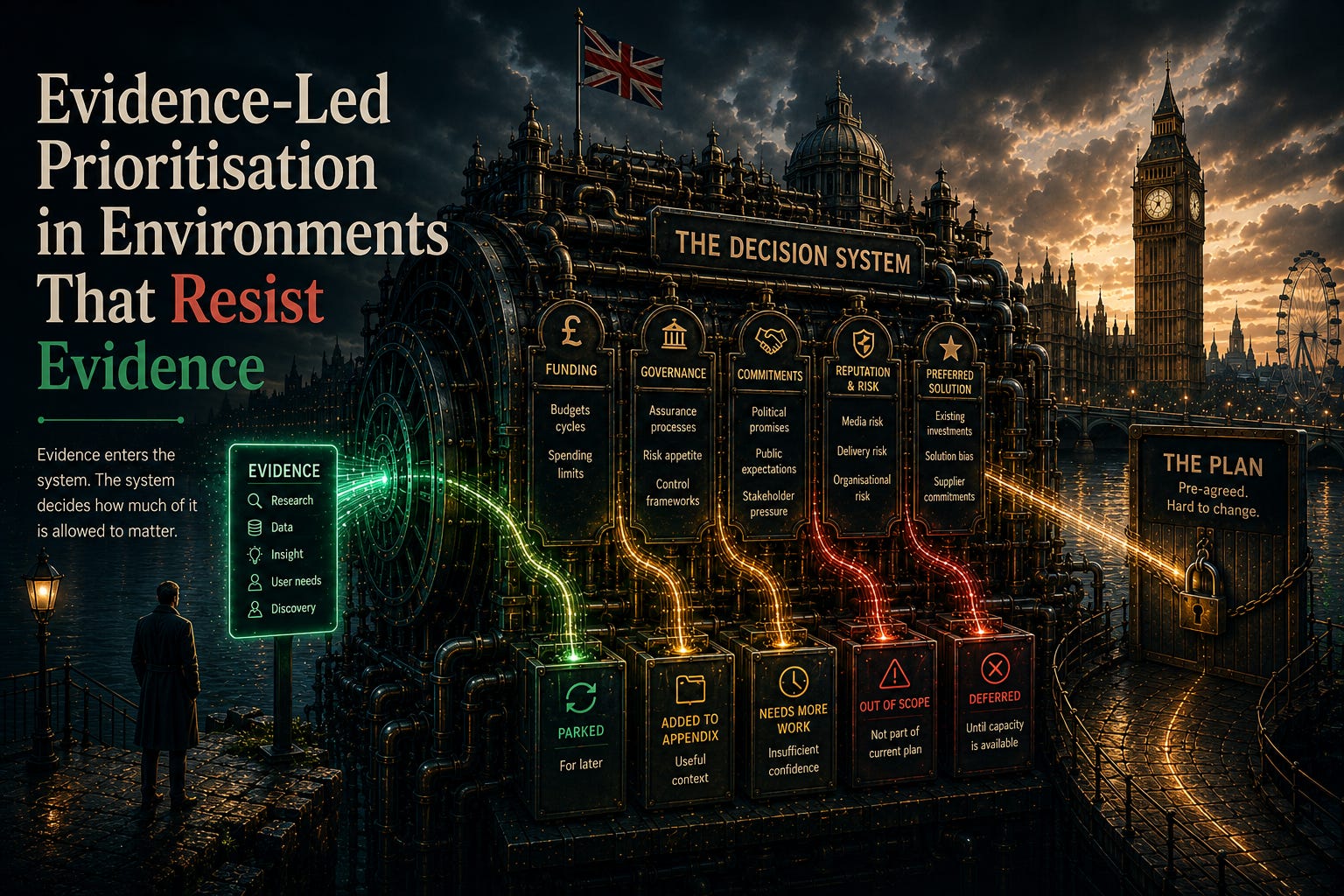
Everyone says they want evidence-led prioritisation until the evidence asks them to change something they have already committed to. That is where the comfortable version of product management starts to break down.
On paper, prioritisation should be straightforward. Understand the user need, look at the evidence, consider value, risk, effort, confidence, urgency and strategic fit, then compare the options and make the best decision available.
In practice, it is rarely that simple.
Teams can produce user research, service data, operational insight, cost analysis, risk assessments and discovery findings. They can make a reasonable case, show where the current plan is weak and identify where work could reduce risk or improve outcomes.
And still, the roadmap barely moves.
The evidence is acknowledged, but not acted on. It becomes “useful context”, gets added to the appendix, or is parked for a later phase.
Better evidence does not automatically lead to better priorities.
Not necessarily because people dislike evidence, or because the organisation is irrational. Often, it is because the decision environment is not set up to respond to the evidence being presented.
That distinction matters.
Evidence-led prioritisation is not just about producing better evidence. It is about understanding whether the organisation can change course when the evidence suggests it should.
The myth of rational prioritisation
A lot of product practice carries an implicit assumption that if the evidence is good enough, the right priority will become obvious.
That is the logic behind many prioritisation frameworks: score the options, rank the backlog, compare value against effort, make confidence visible and create a more structured conversation.
These tools are useful. They help teams move beyond opinion, expose trade-offs and reduce the chance of everything being decided by whoever speaks loudest or holds the most senior title. But they can also make prioritisation look simpler than it is.
Prioritisation is not just a sorting exercise. It is a decision made inside an organisation, shaped by timing, funding, governance, reputation, accountability, delivery pressure, legal constraints, supplier arrangements, senior commitments and inherited plans.
A backlog does not exist outside the system that funds it, governs it and judges it.
This is why evidence-led prioritisation struggles when it is treated as a purely analytical problem. The product team may be asking: “What does the evidence show?”
The organisation may be asking: “What can we safely change, delay or admit without creating wider consequences?”
These are not the same questions.
Why evidence does not always move the roadmap
When evidence fails to change priorities, it is easy to assume the organisation does not care about evidence. Sometimes that may be true. But often, evidence is resisted because it threatens something the organisation is trying to protect.
It may challenge a senior commitment, weaken confidence in a preferred solution or show that delivery started before enough was understood. It may suggest that the most valuable work is not the most visible work.
It may also arrive too late. By the time evidence is presented, the real prioritisation may already have happened through funding decisions, delivery plans, supplier commitments, governance papers, policy commitments or public promises.
The roadmap may appear open, but the wider system may already have narrowed the room for manoeuvre.
This is particularly visible in public sector digital delivery, where priorities are shaped by policy commitments, spending controls, legal duties, assurance, governance and reputational risk. The private sector has its own version of this pattern, shaped by commercial targets, investor expectations, sales commitments and quarterly revenue pressure.
The point is not that evidence is irrelevant. The point is that evidence rarely enters a neutral space.
Insight is not the same as decision evidence
One common mistake is assuming that insight automatically creates movement.
A research finding can be valid. A data pattern can be clear. A discovery recommendation can be well supported. But if the evidence is not connected to a decision the organisation can actually make, it often remains interesting rather than influential.
This is the difference between insight-shaped evidence and decision-shaped evidence.
Insight-shaped evidence shows what has been learned. Decision-shaped evidence shows what the learning changes.
That distinction matters because organisations rarely change direction simply because new information exists. They change direction when the implications are clear, material and actionable enough to affect a decision.
So evidence should not only show that users are struggling with a journey, that a feature has limited demand or that uncertainty exists. It should make the consequence clear: continuing with a known failure point, delaying work with stronger evidence, or committing further investment before a key assumption has been tested.
In environments that resist evidence, describing reality is not enough. Evidence has to clarify the consequence of continuing as planned.
That does not mean being dramatic or adversarial. It means making the trade-off visible, so the organisation cannot treat the evidence as useful background while carrying on as before.
Evidence does not remove organisational reality
A more mature view of prioritisation recognises that evidence does not remove politics from decision-making.
Prioritisation is political in the broadest sense because it allocates attention, money, people, time and legitimacy. Every priority creates a deprioritisation somewhere else. Every roadmap protects some interests and disappoints others.
Evidence can improve this process, but it does not make it neutral.
We talk about “letting the data decide” as if data has authority on its own. It does not. People decide, governance decides, budgets decide. Evidence only matters if there is a route for it to affect those decisions.
If nobody has permission to change the plan, more evidence will not solve the problem. If the funding model rewards new delivery but not maintenance, evidence about operational waste or resilience will struggle to land. If a roadmap has become a reassurance mechanism, evidence that introduces uncertainty may be treated as a problem rather than a contribution.
Evidence-led prioritisation therefore requires organisational literacy. Product managers need to understand not only what the evidence says, but what kind of system the evidence is entering.
When evidence is welcomed but cannot alter direction, sequence, scope or investment, it starts to become performative: product theatre with better artefacts.
Prioritisation as risk reduction
In these environments, it can be more useful to frame prioritisation less as value ranking and more as risk reduction.
The question is not only what is most valuable to build. It is what uncertainty needs to be reduced before the organisation commits further. This changes the conversation.
Discovery becomes a way of protecting decision quality, not just an upfront phase. Alpha work becomes a structured attempt to test assumptions before locking into scale. Operational improvement becomes a way of reducing failure demand, cost and friction, not just tidying up the edges.
This matters because evidence does not always need to justify a complete change in direction. Sometimes its job is to stop the organisation committing too early, too heavily or too confidently to something it does not yet understand.
That is often where evidence-led prioritisation becomes most useful: not as a way to produce the perfect ranked list, but as a way to sequence work so the organisation avoids expensive mistakes.
Small moves are still moves
In environments that resist evidence, the choice is not always between full reprioritisation and failure. Sometimes the work is to create enough movement for the evidence to stay alive.
An organisation may not accept a major change in direction, but it may accept a time-boxed experiment, a staged investment decision or further validation before scaling.
This is not about settling for tokenism. It is about understanding the amount of change the system can currently tolerate, then using that movement to create better evidence, stronger confidence and a more defensible next decision.
A useful product stance is not simply: “The evidence says no.” It is more often: “The evidence suggests we should not fully commit yet. Here is the smallest responsible step that reduces uncertainty, protects delivery and gives us a better decision point.”
In complex systems, changing direction safely can be more important than pushing for a complete reversal.
The real test
Weak evidence-led prioritisation says: “Here is the evidence, therefore this should be the priority.”
Stronger evidence-led prioritisation says: “Here is what the evidence changes, what remains uncertain, what is at risk, and what the lowest-risk next decision should be.”
The first assumes the organisation is ready to act rationally. The second recognises that organisations often need help to change their mind safely.
The real test is not whether a team can produce a prioritised backlog, apply a framework, conduct research, review analytics or score options.
The real test is whether evidence has permission to affect the plan.
That does not mean changing direction constantly, treating every new insight as disruption, or ignoring strategy, governance and commitments. It means being honest about whether priorities can change when the evidence says they should.
Because if priorities are fixed regardless of what is learned, the organisation is not prioritising. It is sequencing pre-agreed commitments.
And if evidence is only welcome when it confirms the existing direction, it is not evidence-led. It is evidence-decorated.
The best product teams do not simply bring more data into resistant environments. They understand why the resistance exists and they shape evidence around decisions, expose trade-offs, reduce uncertainty and create safer routes for change.
They do not pretend that evidence removes organisational reality. They use it to improve the quality of decisions made within it. That is the harder and more useful version of evidence-led prioritisation.
Not a clean framework, ranked list or ritual of confidence. But the disciplined, often uncomfortable act of helping organisations make better choices when their own systems make those choices difficult.