

Decision debt develops when a choice remains unresolved for long enough that the deferral begins shaping the organisation as much as an explicit decision would.
I saw this when I returned to an established public-sector product area following a change in leadership.
The project had reached an important point in its development, but its future direction and scope were no longer sufficiently clear. Teams continued delivering, yet there was no shared answer to what the product was becoming, what needs it should prioritise or how the different strands of work should fit together.
Engineering had not stopped. Priorities, backlogs and stakeholder expectations had continued to form around the uncertainty.
By the time I returned, choosing the next set of features would not have resolved the underlying problem. The strategy itself had to be reset, we needed to reconnect the roadmap to a clear purpose, consolidate fragmented work and establish a coherent direction for continued delivery.
The organisation had not avoided making choices, but rather it had allowed a series of local choices to accumulate in the absence of a clear central one.
Product teams already have familiar language for compromises that make software harder to change: technical debt. A shortcut may create short-term value, while future teams pay interest whenever they have to work around its consequences. Organisations accumulate a related form of debt through the choices surrounding their products. This is often referred to as decision debt.
I have come to see decision debt as three distinct failures in the lifecycle of a choice: decisions that remain unmade, decisions that can no longer be traced and decisions that were never revisited.
Three forms of decision debt
Unmade decisions
An unmade decision is an important choice that remains unresolved while dependent work continues. Some questions can stay open with little consequence. Others sit upstream of several teams, investments or services. When clarity does not arrive, people create assumptions so that work can proceed.
Those assumptions may be reasonable and sometimes unavoidable. But they remain local answers to a question that required wider ownership.
The result is rarely complete paralysis. It is movement in several subtly different directions. The central decision has not disappeared, it has been distributed across the organisation.
Untraceable decisions
An untraceable decision has been made, but its reasoning can no longer be reliably recovered.
People know what the organisation currently does, but struggle to explain:
why that approach was chosen
what evidence informed it
which alternatives were rejected
which constraints applied at the time
what would justify reconsidering it.
A lightweight decision record can preserve the context and consequences of an important choice. Without that context, later teams may be forced either to accept the decision blindly or reverse it without understanding its purpose.
I encountered a version of this while reviewing a public-sector initiative that had already passed through an earlier discovery phase. The previous work had produced conclusions and presentation material pointing towards a digital intervention. The direction appeared to have been established and later discussions were beginning to treat it as the logical next step.
What was missing was a defensible evidential baseline. There was no reliable view of the existing cost of the problem, the frequency and nature of the work involved, the proportion technology could realistically improve or whether smaller changes might produce more value than a significant digital investment. The apparent decision had travelled further than its reasoning.
We returned to first principles. We reconstructed the problem, examined the existing process, tested the assumptions behind the proposed intervention and compared several possible responses. The eventual recommendation combined lower-cost improvements with a limited pilot. This preserved the option to invest further once stronger evidence existed.
The problem was that the organisation could no longer demonstrate why the earlier direction was justified. Without that context, the next team faced two poor choices: accept the inherited direction without scrutiny or discard it and repeat the discovery from the beginning.
Unrevisited decisions
Some choices are sensible when first made and damaging only because they outlive the conditions that justified them, for example: a temporary approval stage introduced during a high-risk launch that remains years later.
The original choice gradually disappears into routine. This makes unrevisited debt particularly difficult to detect. Open questions remain visible because people are still discussing them and outdated answers can become indistinguishable from the environment itself.
A process may be defended as “the way things work” even though it was originally intended as a temporary control and the organisation stops experiencing the arrangement as a decision and starts treating it as a fact.
When decisions lose their context
A weak choice that is visible, reversible and quickly corrected may leave little lasting damage. A reasonable one whose context disappears can constrain an organisation for years, the cost is reduced adaptability.
When nobody can explain why a choice was made, future teams cannot confidently decide whether to preserve, challenge or replace it. They either inherit it as unquestionable wisdom or repeat the work required to reconstruct the original debate.
Organisational memory is held in many places: people, routines, systems, documents and relationships. When the reasoning behind important choices exists mainly in individual recollections, staff movement removes more than delivery capacity. It removes part of the organisation’s ability to explain itself.
How decision debt compounds
Decision debt rarely grows through one act, it develops through feedback.
An unresolved question forces teams to keep moving - they adopt assumptions and create workarounds. Those workarounds then produce different solutions, expectations and commitments across the organisation. This in turn makes the original choice harder to resolve.
More people must now be aligned, more existing work is placed at risk. Stakeholders become invested in approaches developed around their own assumptions and governance expands to manage the resulting disagreement.
A temporary delay becomes a system that produces further delay.
The diagram below uses a causal loop model to show how these effects reinforce one another. I have explained the wider methodology, including causal relationships, polarity, reinforcing loops, balancing loops and delays in Systems Thinking for Product Managers: System Dynamics.
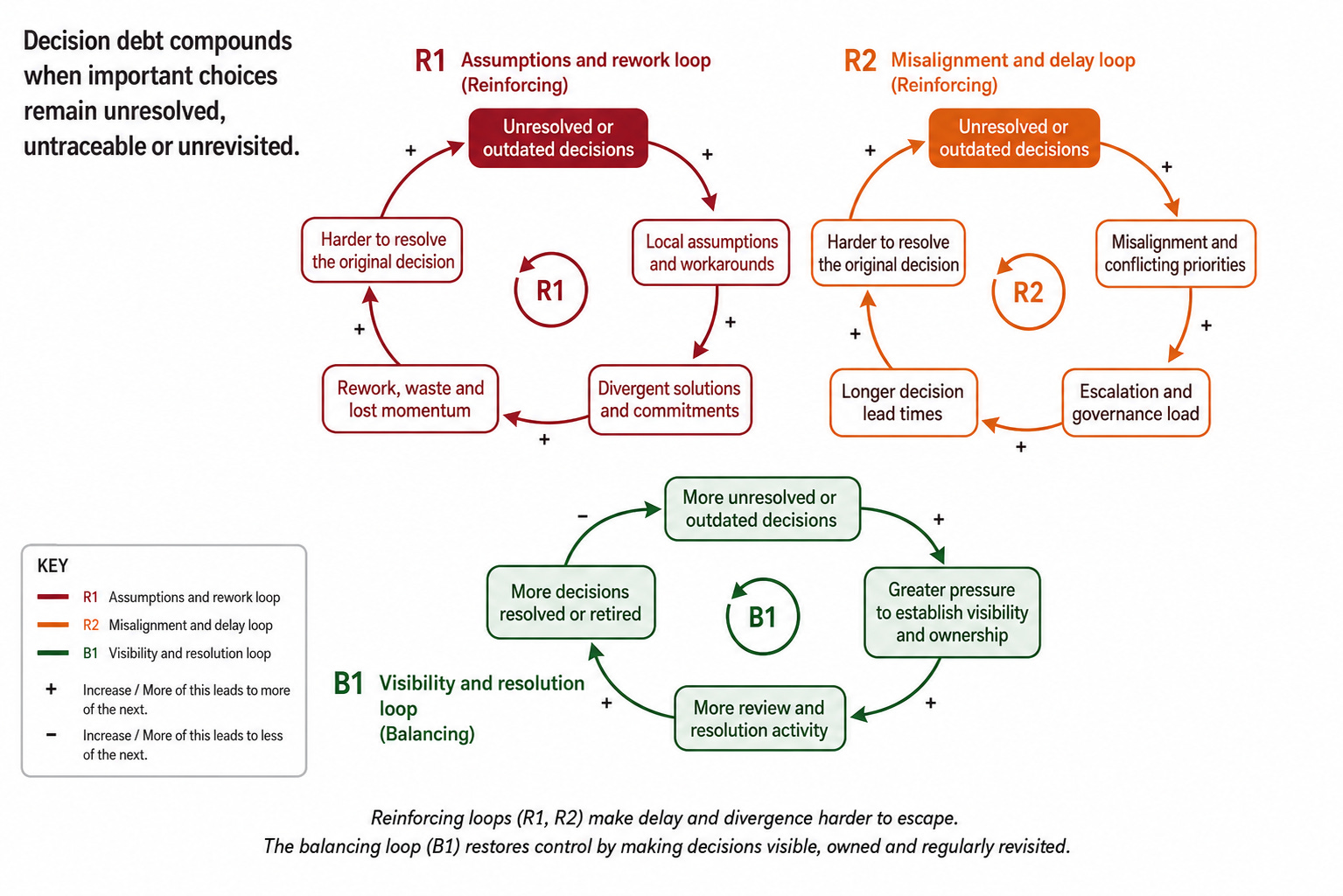
The significance lies in the feedback rather than the individual stages.
Each cycle strengthens the conditions that produced it. Teams accumulate more work, commitments and disagreement around the missing choice. Resolving it becomes increasingly costly, making continued deferral feel increasingly rational.
Local rationality, organisational irrationality
The feedback loops explain the mechanism, they do not imply that those involved are behaving badly.
Teams often respond rationally to the conditions around them. They cannot pause delivery each time a wider strategic question remains unsettled. They make provisional assumptions, narrow scope and optimise for the authority and evidence available to them.
Problems emerge when several reasonable local responses interact, e.g. One team designs for a broad future capability. Another optimises for the immediate requirement. A third creates a temporary workaround while waiting for clarity. Each response may make sense within its own boundaries.
Together, they create an incoherent system. By the time the central choice returns to the agenda, each team has invested in its interpretation. Stakeholders have made commitments based on those investments. Selecting one direction now means abandoning work, revising expectations and acknowledging that some activity began prematurely.
The organisation experiences the result as a delivery problem: duplicated work, difficult dependencies, slower progress and inconsistent user experiences.
Delivery is where the cost becomes visible, whilst the debt was created further upstream.
Where the interest appears
Decision debt rarely arrives with a label, it appears through familiar symptoms:
discovery repeatedly returning to questions examined before
governance meetings that revisit discussion without clarifying ownership
approval processes that survive after the original risk has diminished
work abandoned when an unstated assumption is finally challenged
reliance on a few long-serving colleagues who remember why things are done
stakeholders offering conflicting accounts of an established constraint.
None of these proves that decision debt exists, rework and slow governance have many causes. However repeated symptoms justify looking upstream.
Instead of asking only why a team is struggling to deliver, it may be more useful to ask which unmade, untraceable or unrevisited choice it has been asked to work around.
Open choices and controlled uncertainty
Some decisions should remain open.
Evidence may still be emerging, the environment may be changing. A small experiment may reduce uncertainty. Committing too early may close valuable options without creating a corresponding benefit.
Delay becomes problematic when it stops being deliberate. A controlled deferral has an owner, an explicit reason and a point at which the question will return. Teams know which temporary assumptions they are allowed to use and what might invalidate them.
With unmanaged avoidance, ownership is ambiguous, assumptions remain hidden and the cost of waiting is distributed across other people’s work.
Speed is therefore an inadequate measure of decision quality, a rapidly made irreversible choice can be more damaging than a carefully managed delay.
The aim is to stop uncertainty from becoming invisible.
Making decisions visible
A practical response should be proportionate to the problem. A large template for every decision would create exactly the kind of governance overhead this argument is trying to reduce, a lightweight decision backlog can be enough.
For the relatively small number of choices with significant implications, record five things:
The question: what needs to be decided?
The owner: who is accountable for moving it towards resolution?
The current assumptions: how are teams proceeding while it remains open?
The trigger or review point: what evidence, event or date will bring it back?
The outcome and rationale: once resolved, what was chosen and why?
Dependencies, risks and delivery impacts should remain in the systems where teams already manage them, the decision record should connect to that work rather than duplicate it. This is closer to a queue of organisational questions than a new governance framework.
Its value lies in changing the conversation, e.g. A blocked team can identify the choice behind the blockage or a stakeholder disagreement can be expressed as a specific unanswered question.
Product management and organisational memory
Product management sits between users, strategy, delivery, technology, policy and operations. That position gives product managers a useful view of where a choice in one part of an organisation creates assumptions and costs elsewhere. They can help preserve the reasoning around the decisions that shape the product.
This includes identifying high-impact questions, exposing the assumptions teams are already making, connecting choices to outcomes and retaining enough context for future colleagues to understand what happened.
Product management also requires curiosity about inherited constraints. A decision made several years ago may look inexplicable because the evidence, risks and pressures that shaped it have disappeared. Recovering that context does not mean defending the past. It allows the organisation to distinguish an enduring principle from an expired compromise.
Organisations learn when they can connect earlier choices to their assumptions and eventual consequences. Without that connection, experience becomes history rather than knowledge.
Recovering the decision lifecycle
Product organisations maintain detailed records of features, defects, risks, dependencies and technical compromises, but the choices governing that work are often far less visible.
A healthier decision system gives important choices a visible lifecycle. Questions can be opened, explored, deliberately deferred, resolved, reviewed and eventually superseded. This visibility does not guarantee good judgement but it does make the consequences of delay, the assumptions embedded in delivery and the reasoning behind inherited constraints easier to examine.
I have learned to be wary when a team repeatedly struggles with what appears to be a delivery problem. The visible friction may sit in the roadmap, the backlog or the governance process, but its origin can be further upstream.
Sometimes the work is difficult because the organisation has not made a choice, sometimes it has made one but can no longer explain it and sometimes it is still living with an answer to a question that nobody has thought to ask again.
An organisation’s ability to change depends partly on whether it can still explain how it arrived where it is.