

The shift we’re missing
AI isn’t replacing product managers, it’s exposing them.
The dominant narrative is that AI will automate large parts of the role. Such as writing requirements, summarising research and proposing solutions. In many ways, that’s already happening. But the more important shift isn’t about what AI can do. It’s about what it reveals when those things are no longer where the value sits.
The illusion of control
Product management has always occupied an ambiguous space between ownership and coordination. We talk about outcomes but measure output. We talk about responsibility but distribute it across teams, processes and artefacts.
In practice, it has been possible to appear effective, maintaining a well-structured backlog, facilitating delivery, keeping stakeholders aligned, etc. Without ever being fully accountable for what happens once the work is released into the world.
In more complex settings, particularly the public sector, this pattern becomes pronounced. I’ve worked in programmes producing vast amounts of documentation, detailed, carefully structured, well-intentioned, that in practice said very little. Quickly outdated, rarely revisited, loosely connected to the decisions being made day to day. The system keeps moving, but responsibility stays diffuse.
When the work becomes trivial
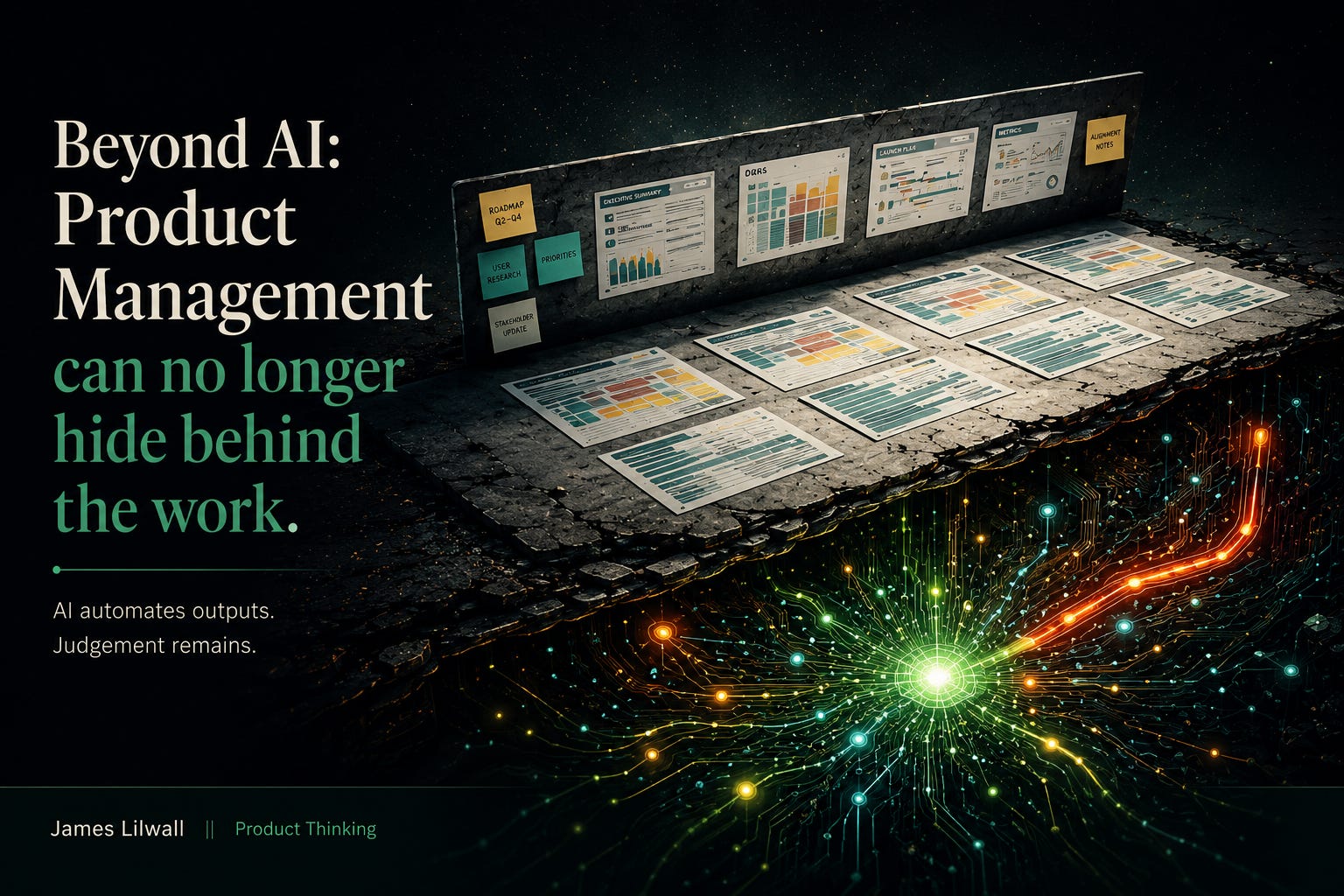
AI doesn’t disrupt product management by replacing it. It disrupts it by making much of it trivial.
When requirements, summaries and solution options can be generated instantly, the activities that once signalled “Product Management” lose their weight. They become easier, faster and ultimately less valuable.
The role no longer centres on producing clarity. It centres on deciding what that clarity should lead to.
As Gibson Biddle has described, the leverage in product work comes from a small number of high-quality decisions. When the number of possible options expands, as AI ensures it will, then the quality of those decisions becomes the only differentiator.
From translation to judgement
Much of product work has historically been translation: taking inputs from users, stakeholders, policy and technology and turning them into something a team can act on. That required effort, e.g. synthesis, structure, clarity. It was the visible centre of the role.
AI compresses that effort. Translation becomes quicker, lighter, more accessible. And as a result, the centre of gravity shifts away from producing representations of work and towards something less tangible but more consequential: deciding between possibilities.
In environments where decision-making is already constrained, where governance is layered and authority is distributed, this shift becomes even more visible. The challenge is no longer producing the right artefacts. It’s creating the conditions where meaningful decisions can actually be made. That is not something AI can solve.
Systems, not stories
Answering those decisions well requires a perspective that extends beyond individual features or user stories. Product decisions exist within systems, combinations of user behaviour, technical constraints, organisational incentives and external forces like policy and regulation.
These systems are dynamic. Outcomes emerge from their interactions, not from any single action.
Donella Meadows made this point clearly: interventions in a system cannot be understood in isolation. A change in one part creates effects elsewhere, often in ways that aren’t immediately visible. The artefact may be correct, but the system response is not.
Where AI stops
AI can help explore these systems. It can surface patterns, generate hypotheses, propose interventions.
But it doesn’t exist within the system the way a product team does. It doesn’t experience constraints directly, or bear the consequences of decisions as they unfold. It doesn’t navigate bureaucratic structures or work in the space between policy and delivery, where decisions are shaped as much by context as by logic. It doesn’t sit in a room where authority is limited and influence has to be built over time.
It produces outputs that are plausible and often useful. But it carries no responsibility for what happens when those outputs are acted upon.
What remains
As the activities that once defined the role become easier to automate, what remains is the moment a decision is made and the responsibility for that decision becomes real.
This is less visible than a roadmap or a set of requirements. But it is where the actual impact of product management lives.
In practice, it means working within constraints that cannot be removed, only navigated. Making decisions with incomplete authority and still being accountable for outcomes. Recognising that the system you operate within shapes what’s possible, without letting that become an excuse to abdicate responsibility.
What this means in practice
The artefacts no longer carry the weight. If AI reduces the cost of producing them, product management cannot continue to define itself by them. A clear requirement or a well-structured backlog will no longer be enough to signal value.
The problem matters more than the solution. When multiple solutions can be generated quickly, the real leverage is in identifying the right problem. A poorly framed problem just means faster production of the wrong outcomes.
Trade-offs become unavoidable. More options don’t remove constraints, they sharpen them. Decisions between speed and sustainability, short-term delivery and long-term system health, become more explicit and harder to defer.
Systems thinking becomes essential. Without understanding how decisions interact with organisational, technical and policy constraints, even well-reasoned choices produce unintended consequences.
Accountability becomes visible. As artefacts become easier to produce, they can no longer absorb responsibility. The link between decision and outcome becomes harder to distance yourself from.
The uncomfortable truth
Part of what AI is revealing is that some elements of product management have been more performative than we might like to admit. Well-structured artefacts can give the impression of clarity. Well-run processes can give the impression of progress. Even when the underlying decisions haven’t been resolved. AI removes some of that cover.
The question that matters
The future of product management isn’t defined by how well we use AI tools. It’s defined by how clearly we understand the part of the role that can’t be delegated.
It’s a shift away from production and towards accountability, from describing work to taking responsibility for its consequences. The question is no longer how to incorporate AI into product management. It’s what we are prepared to be responsible for when the tools can do much of the rest.