

AI safety is usually discussed in terms of what the technology might do: whether models become too capable, whether they can be misused or whether development is moving faster than our ability to control it.
I’ve written before about responsible AI having an evidence problem and I think there is a similar problem with how we have defined safety. We have drawn the boundary around the model and what it might do, while the physical system needed to build and run it sits somewhere outside.
AI depends on data centres, electricity, grids, chips, water and materials. The environmental consequences of scaling that system have largely been separate from the AI safety conversation from the start.
I suspect part of the reason is that growth and investment took priority early. Technology is exciting, it attracts money, attention and status and society tends to reward the companies pushing it forward. Environmental impact is often treated differently, more as a constraint on growth or an additional cost than something that should shape the decision in the first place.
In my experience, sustainability tends to get more attention when it connects to regulation, reputation, cost or sales. I remember a period through the 2000s and 2010s when being visibly environmentally conscious felt more commercially attractive in its own right. I’m less convinced it carries the same weight now, particularly when it is competing with growth and the opportunity to move quickly on AI.
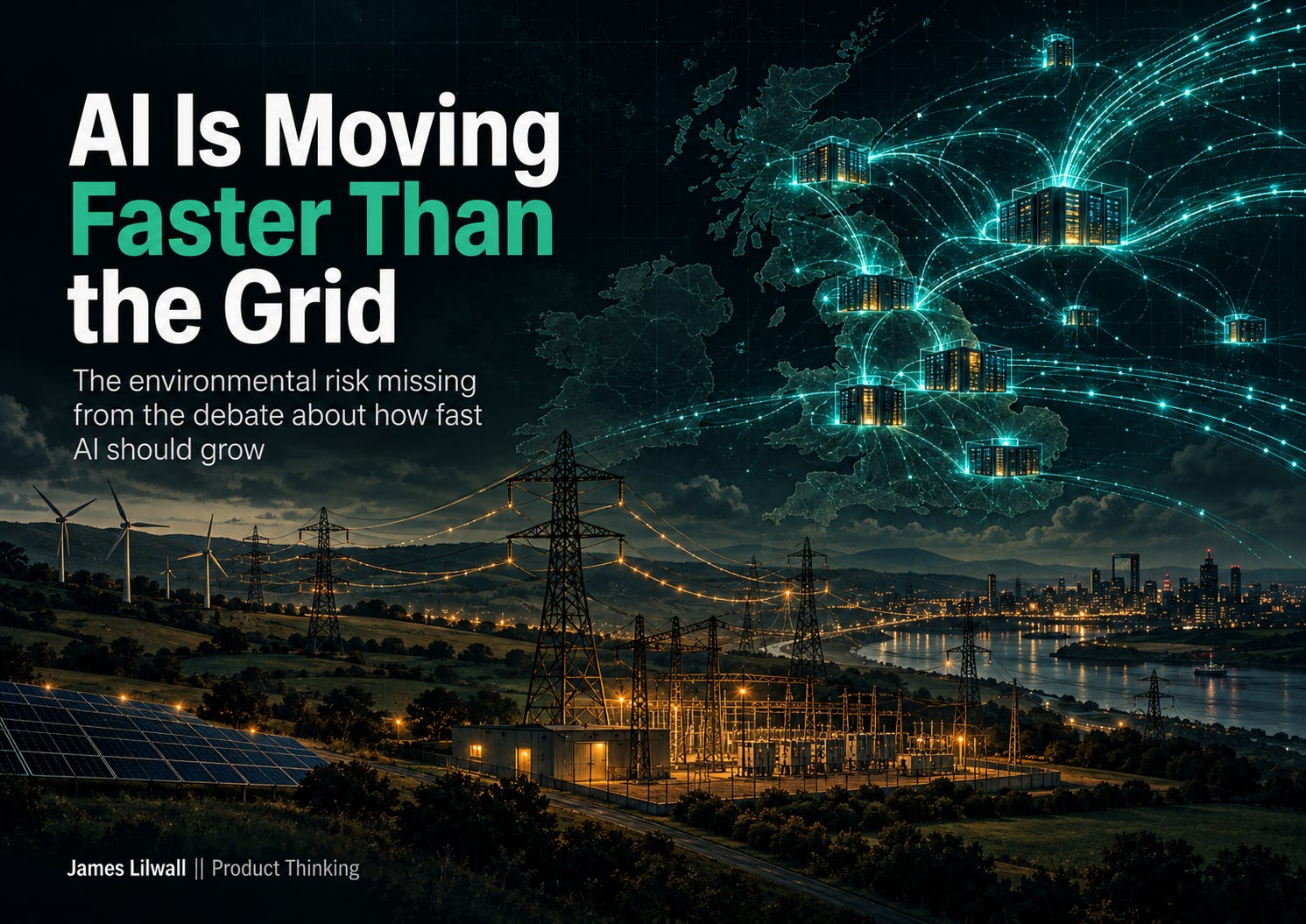
The problem is not simply that AI uses a lot of electricity, it is that AI can scale much faster than the physical systems needed to power it sustainably.
AI and the grid move at different speeds
The International Energy Agency’s analysis of energy demand from AI expects global data-centre electricity use to more than double to about 945 TWh by 2030, with AI the largest driver of that increase. That would still be less than 3% of global electricity consumption, so this is not an argument that AI is about to consume all of the world’s electricity.
Renewable generation is growing too, the problem is whether enough clean electricity can be built and connected where demand appears, quickly enough.
The difference in timescales is striking. The IEA’s 2026 analysis of electricity grids estimates that new data centres can be built in roughly one to three years, while major grid infrastructure can take five to fifteen. More than 2,500 GW of renewable generation, large-load and storage projects are already sitting in grid connection queues around the world.
A model can be released, additional compute deployed and usage expanded while the transmission infrastructure needed to support that growth is still being planned.
AI can move at technology-sector speed, whilst the grid cannot.
There is an important counterargument, AI could also help improve the energy system it is putting pressure on and could lead to technological advancements. The IEA’s work on AI for energy optimisation estimates that AI applications could unlock up to 175 GW of additional transmission capacity from existing power lines, alongside uses in forecasting, renewable integration, network operation and energy efficiency.
AI demand could also help bring forward investment in low-carbon generation and new grid infrastructure. But those benefits should be visible rather than assumed. If AI growth is genuinely accelerating sustainable infrastructure, we should be able to see that in the generation being built, the grid capacity being added and the environmental performance of the companies creating the demand.
The electricity has to come from somewhere
This new demand is arriving while the wider energy transition is already under pressure.
The World Meteorological Organization’s State of the Global Climate 2025 report says 2015 to 2025 were the hottest 11 years on record, with 2025 around 1.43°C above the 1850–1900 average. UNEP’s Emissions Gap Report 2025 estimates that current policies put the world on a path towards around 2.8°C of warming.
Some climate consequences may already be unavoidable. I do not think that removes responsibility for what happens next; it makes the choices about how new demand is powered more important.
AI did not create the climate crisis, but we are choosing to add a rapidly growing source of electricity demand at the same time as transport, heating and industry also need to electrify. That creates an allocation problem as well as a generation problem.
The UK Government’s Compute Roadmap forecasts that the country will need at least 6 GW of AI-capable data-centre capacity by 2030, around three times the capacity available when the roadmap was produced. Its AI Growth Zones are intended to support at least 500 MW each, with at least one expected to exceed 1 GW.
The government’s AI Growth Zone criteria already require sites to demonstrate access to at least 500 MW of power by 2030 and enough water to support infrastructure at that scale.
I am not saying AI should not get that electricity. I am saying that allocating grid capacity, new generation and infrastructure investment to AI is a choice. If one sector can deploy capital and create demand much faster than the grid can expand, we should be asking what else needs additional investment or waits longer as a result.
Responsibility should sit with the companies creating the demand
Companies building increasingly powerful models should take more responsibility for the energy consumption they create.
If new data centres are required, sustainable power supply should be part of the plan for those sites rather than something accounted for afterwards. Companies should also show how growing AI demand affects their path towards net zero, rather than relying only on distant corporate targets that may have been set before the current level of AI investment was anticipated.
There is a transparency problem too. I use these tools regularly, but as an individual user it is still surprisingly difficult to understand the environmental impact of the choices I make between models. I can see price, tokens, speed and capability. Environmental impact is largely hidden.
Some of that is understandable because the calculation depends on hardware, utilisation, model architecture, data-centre efficiency and the electricity supplying it. But the lack of visibility goes beyond measurement difficulty. Stanford’s 2025 Foundation Model Transparency Index found that ten companies disclosed none of the key environmental information it assessed, including energy use, carbon emissions and water use.
If people cannot see the impact, it is difficult to expect them to make decisions around it.
I also do not think responsibility should be pushed entirely onto the user. The better principle is to use the right model for the right task. Sometimes the most capable model is exactly what is needed, but if a smaller model can do the job well enough, using a much larger one simply because it is available makes little sense.
If AI companies can understand a task well enough to route it to an appropriate model, environmental efficiency can become part of that decision rather than another burden placed on the user. The task still gets done, it should cost less and it uses less unnecessary compute.
There is an uncomfortable tension here though: providers may make more money when people use more expensive models.
Product has been detached from this for too long
I think Product Managers have been too detached from the environmental consequences of what gets prioritised.
We are used to balancing user needs, commercial value, cost, risk and delivery effort, while environmental impact is much less likely to sit in the same conversation. That reflects what organisations reward. If growth and profit are visible and immediate while environmental consequences are harder to measure and often owned somewhere else, those are the pressures Product Managers will feel when prioritising.
AI gives us an opportunity to change some of that because Product Managers are becoming closer to building again. We can experiment directly with models, prototype much more quickly and increasingly understand the technical choices being presented to us.
Being closer to those choices should mean understanding their consequences better as well. When we choose a model, set a default, design routing or decide whether a capability genuinely needs the most powerful model available, environmental impact should sit alongside cost, latency, quality and risk as one of the consequences we understand.
That does not mean avoiding AI, always choosing the smallest model or pretending environmental impact should override every other consideration. It means treating it as one of the consequences of the choice rather than something outside the boundary of Product.
Responsible AI growth, for me means companies building infrastructure with sustainable power available, showing how increasing demand fits with credible net-zero plans and giving people enough transparency to understand the consequences of their choices. It also means designing systems that use the right model for the task rather than assuming every problem needs the most powerful model available.
We may already be too late to avoid some climate impacts. I do not think that is a reason to care less about what happens next.
We are asking whether AI could threaten the future of humanity. The environmental systems humanity already depends on should have been part of that conversation from the start.